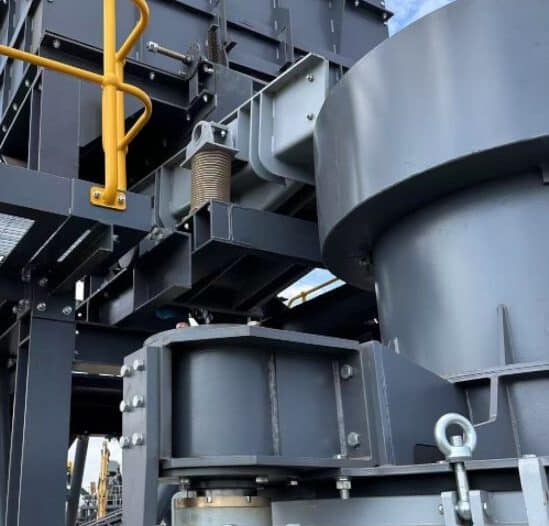
A feeder that fails quietly is still governed by inputs that can be measured precisely. Four material characteristics determine which feeder type belongs in your circuit — and where in the circuit it belongs. Getting these right at the specification stage is what separates a feeder that disappears into reliable operation from one that becomes a recurring maintenance conversation.
Missed Part 1? Read “Feeder Selection: The Decision That Shapes Your Entire Circuit” first for the case behind why this decision carries more weight than it usually gets.
The Four Variables That Determine Feeder Selection
Feeder type cannot be determined without first characterizing the material. These four variables are non-negotiable inputs to the specification process.
1. Feed Size
Maximum feed size is the primary structural constraint. It determines which feeder types are physically capable of handling the material without sustaining damage at the feed point. Every feeder in the AMPCO Minerals range is engineered for a defined feed size envelope. Specifying outside that envelope, even marginally, creates structural stress at the feed point from the first day of operation. In a primary feed application where run of the mine (ROM) material arrives at variable sizes, confirming the maximum feed size against actual blasting and loading data, not theoretical estimates, is an essential first step.
2. Moisture and Clay Content
This is the variable most likely to be underestimated, and the one with the most dramatic consequences when it is. Above certain thresholds, material stops flowing freely. It packs, bridges, and sticks. Vibrating feeders rely on throw and frequency to move material. Those mechanisms become progressively less effective as moisture and clay content increase. At high enough levels, they stop working entirely.
The failure mode is a feeder that appears to be operating but is not feeding. Material sits stationary on the pan, held by its own cohesive strength. Operators increase speed or amplitude. The feeder sustains damage, or simply generates more vibration that the material absorbs without moving. The right answer is a different feeder type, not a higher setting.
This is specifically what the Wobbler Feeder is designed for. Its low-speed rotating bar action is effective at breaking up and conveying cohesive material that would be problematic for a vibrating feeder. If moisture and clay content is a factor in your feed, it belongs in the specification conversation.
3. Abrasiveness
Abrasive material wears feeder surfaces at rates that vary significantly across feeder types and construction specifications. An Apron Feeder utilizes heavy-duty pans built to withstand abrasive ore environments. A Pan Feeder lining is configurable. A Belt Feeder belt specification is selected for the material it will carry. Specifying a standard-construction feeder for a highly abrasive application produces higher-than-planned maintenance costs from the first operating period.
4. Bulk Density and Surge Conditions
Bulk density dictates feeder sizing and connected power. Heavier material requires a physically larger machine and higher torque to move the same tonnage as a light material. Sizing a unit for one and running the other over it puts you outside the design envelope. Surge conditions matter equally. A primary feed point receiving blasted ROM from a truck dump experiences peak instantaneous loads well above average throughput. The feeder structure and drive system both need to be engineered for peak surge, not average rate.
Material characterization is the foundation of feeder selection. The same variables that inform crusher and screen selection, feed size, moisture and clay content, abrasiveness, and bulk density, determine which feeder is correct for the application.
Read more: How to Define Your Mineral Processing Circuit
Circuit Position: Where the Feeder Sits Defines Its Demands
Material characteristics define the feeder type. Circuit position defines the operating demands. Both inputs are required for a correct specification.
Primary Feed
Primary feed points receive run-of-mine material directly from blasting or extraction. Feed size is large and highly variable. Surge loads are unpredictable. This is the most demanding feeder position in the circuit.
Apron Feeders are the primary tool for this application. Their heavy-duty construction handles the impact loads and material variability that conventional feeders cannot. Grizzly Feeders serve the same position and add pre-screening, diverting undersized material before the crusher to protect it from unnecessary load.
Where feed material is moderately wet or sticky, the Apron Feeder handles those conditions well. For heavily clay-laden, high-moisture, or clogging-prone material, the Wobbler Feeder replaces the Grizzly Feeder, conveying cohesive material that would cause conventional vibrating feeders to underperform, while removing fines before the crusher in the same unit.
In applications where surge loads are high and material is wet or sticky, an Apron Feeder and Wobbler Feeder are often used together: the Apron absorbs the impact load at the feed point and regulates flow, while the Wobbler handles pre-screening and fines removal before material reaches the crusher.
Secondary and Tertiary Positions
Downstream of the primary crusher, material is already sized, feed rate is more consistent, and surge absorption is less critical. Feed rate precision becomes the primary requirement. Pan Feeders are well suited here: compact, VFD-adjustable, and appropriate for granular and medium-sized material in both floor-mounted and suspended configurations. Belt Feeders serve applications where continuous, steady volumetric flow takes priority over compactness.
Screen Feed Applications
A screen operates at peak efficiency when fed a consistent, even material stream that distributes across the full deck width. Uneven or surging feed creates concentrated loading on part of the deck, degrades separation efficiency, and accelerates localized wear. The feeder ahead of a screen needs to deliver not just the right rate, but the right distribution, a distinction that is easy to overlook at the selection stage.
The AMPCO Minerals Feeder Range at a Glance
Five feeder types cover the applications encountered across mineral processing and aggregate operations. They are not interchangeable. The table below compares maximum feed size, capacity, and the primary advantage of each AMPCO Minerals feeder.
| Feeder | Best For | Max Feed Size | Max Capacity | Key Advantage |
|---|---|---|---|---|
| Apron Feeder | Heavy primary feed; ROM and sticky material | 1,100 mm / 43 in | 2,700 mtph / 2,976 stph | Absorbs surge; handles viscous feeds |
| Wobbler Feeder | Wet, sticky, clay-rich primary feed with pre-screening | 1,400 mm / 55 in | 1,542 mtph / 1,700 stph | Self-cleaning bars; combined feeding and pre-screening |
| Grizzly Feeder | Primary crusher feed with pre-screening | 1,300 mm / 51 in | 1,250 mtph / 1,378 stph | Bypasses fines before the crusher |
| Pan Feeder | Mid-to-small material; secondary and tertiary positions | 500 mm / 20 in | 960 mtph / 1,058 stph | Low noise; VFD-adjustable; multiple mounting options |
| Belt Feeder | Controlled feed rate for mid to smalls size materials. | Custom | Custom | Smooth continuous flow; starts under full load |
Apron Feeder: Primary Feed, Heavy Duty
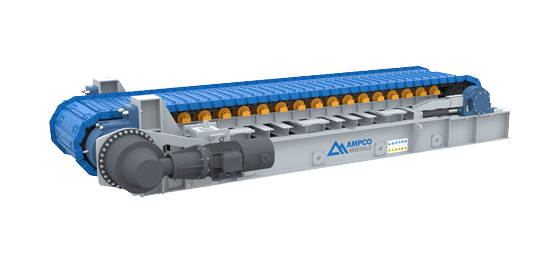
The Apron Feeder is built for the most demanding primary feed applications: large ROM material, high surge loads, abrasive ores, and sticky or viscous material that would choke lighter feeders. Heavy-duty overlapping steel pans absorb large impacts and eliminate spillage along the conveying length. Sealed-for-life chain and carrier rollers reduce routine maintenance requirements. A variable-frequency drive gives plant engineers and operators precise, stepless control over feed rates. Available in a variety of feeder lengths, with capacities from 450 to 2,700 mtph and maximum feed sizes from 400 to 1,100 mm.
Wobbler Feeder: Wet, Sticky, and Clay-Rich Material
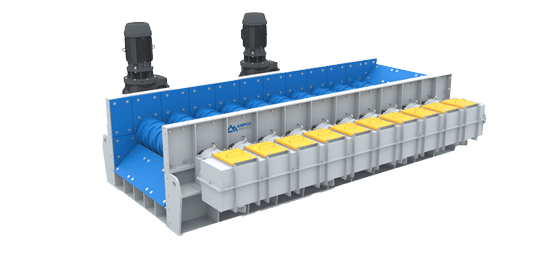
When feed material is high in moisture or clay content, the Wobbler Feeder replaces or supplements the Grizzly Feeder. Its low-speed rotating bar action conveys cohesive material that would stall a vibrating feeder, without generating the high-frequency vibration loads that vibrating feeders impose on supporting structures. Feeding, pre-screening, and fines removal happen in a single unit. The roller gap ranges from 60 to 100 mm across all models; the right model is selected based on your feed size and throughput requirements. Capacity ranges from 227 to 1,542 mtph across the range, with maximum feed sizes up to 1,400 mm. Four models are available.
Grizzly Feeder: Primary Crusher Feed With Pre-Screening
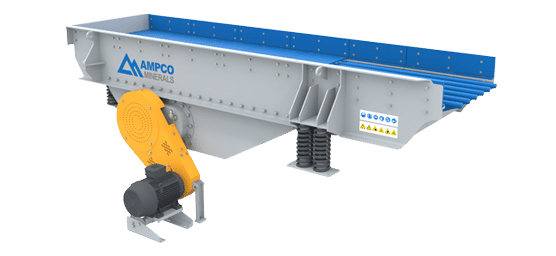
The Grizzly Feeder feeds the primary crusher and pre-screens material in a single unit. The grizzly bar section allows undersized material to bypass the crusher entirely, reducing wear on crushing surfaces and protecting the crusher from unnecessary load. A frequency inverter maintains optimal crusher loading. Bar gap is configurable from 70 to 160 mm; bar type (cast grizzly bars, fabricated bars, or finger tines) is specified based on material characteristics.
An under-grizzly screen section is available based on the requirements of your specific application. In aggregate plants, it removes natural fines and dirt from the bypass stream before they can contaminate clean crushed aggregate further down the circuit. In crushing circuits, it removes fines ahead of the secondary crusher, reducing the prescreening load that would otherwise be required downstream. The under-grizzly screen section is a factory-installed option. Sixteen models are available, with capacities to 1,250 mtph and maximum feed sizes to 1,300 mm.
Pan Feeder: Granular and Mid-to-Small Material
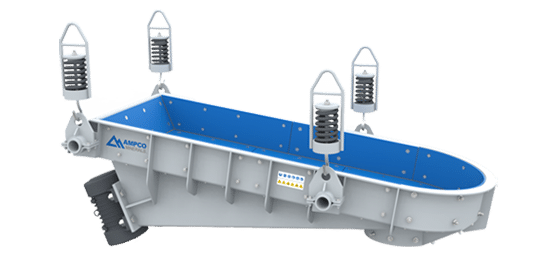
The Pan Feeder delivers continuous, even feed for granular and medium-sized material in secondary and tertiary circuit positions. Available in floor-mounted and suspended configurations, and with a fully open-ended discharge design for uniform feeding or a conical discharge option, a specialized configuration engineered to deliver a uniform, centered feed directly into crushers. VFD-compatible for adjustable feed rate control. Adjustable counterweights are used to increase throw via kinetic energy and are adjustable based on material and throughput requirements. Ten models are available, with capacities to 960 mtph and maximum feed sizes to 500 mm.
Belt Feeder: Controlled Volumetric Feed
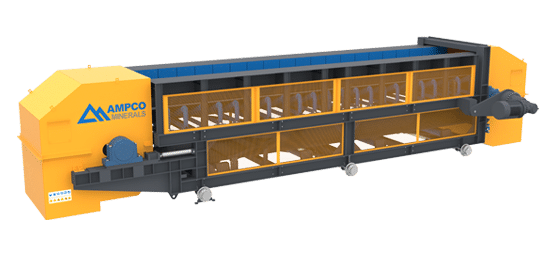
Where consistent volumetric flow is the priority and surge absorption is less critical, the Belt Feeder delivers a smooth, continuous material stream. Custom-engineered to the application, hopper design, belt specification, idler arrangement, and drive configuration are all defined by your material, throughput target, and installation geometry. Available in flat and inclined configurations. Capable of starting under full load.
Specifying the right feeder is half the equation. The other half is recognizing when an existing feeder is already working against your circuit — usually disguised as a crusher, screen, or maintenance problem. Part 3 covers the most common misdiagnoses, and how AMPCO Minerals approaches feeder selection as part of full circuit design.