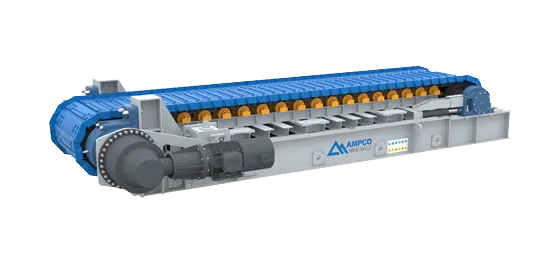
Apron Feeders
Learn More

AMPCO Minerals
Handle Wet, Sticky, and Clay-Rich Feed
Without Disrupting Your Circuit
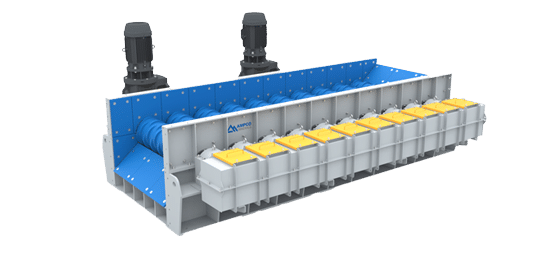
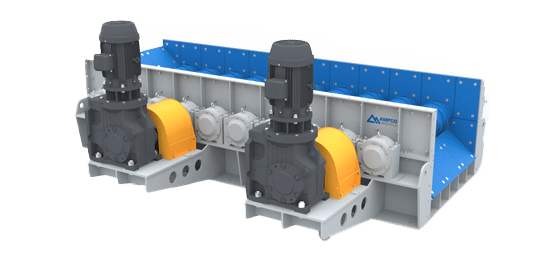
When your feed material is wet, sticky, or clay-rich, conventional Grizzly Feeders can struggle. Material builds up, grizzly sections blind over, and crushers absorb the surge and the fines together. The Wobbler Feeder is engineered specifically for these conditions — combining feeding, and pre-screening into a single unit that keeps material moving and protects the equipment downstream.
Operating on a low-speed wobbler principle, it eliminates high-frequency vibration for stable, consistent performance across the full range of high-moisture and clogging-prone applications.
| Model | Width (mm) | Max Feed (mm) | Roller Gap (mm) | Power (Kw) | Capacity (mtph) |
|---|---|---|---|---|---|
| WF1010 | 1,000 | 800 | 60 -100 | 15Kw×2 | 227 – 454 |
| WF1210 | 1,200 | 1,000 | 60 – 100 | 22Kw×2 | 363 – 635 |
| WF1510 | 1,500 | 1,200 | 60 – 100 | 30Kw×2 | 544 – 1,089 |
| WF1810 | 1,800 | 1,400 | 60 – 100 | 37Kw×2 | 726 – 1,542 |
What materials is the Wobbler Feeder designed to handle?
The Wobbler Feeder is engineered for high-moisture, sticky, and clay-rich feed materials that cause blinding, clogging, or erratic flow in conventional Grizzly Feeders. Typical applications include run-of-mine ore, clay-bearing aggregates, and wet feed in recycling and quarrying operations. If your material tends to pack, clog, or bridge, this feeder is worth evaluating for your circuit.
How does the Wobbler Feeder differ from a Vibrating Grizzly Feeder?
A Vibrating Grizzly Feeder relies on high-frequency vibration to move and screen material — a mechanism that loses effectiveness when feed is wet or sticky, and that introduces vibration load into the supporting structure. The Wobbler Feeder operates at low speed with a rotating bar action, which is more effective at separating and conveying cohesive material while producing significantly lower vibration and noise levels.
Can the Wobbler Feeder handle large feed sizes and heavy loads?
Yes. The frame and wobbler bars are built for large material impacts and continuous heavy-duty operation. Specific feed size and capacity ranges depend on the model — contact us with your material characteristics and throughput target, and we will confirm the appropriate configuration.
What screening gap options are available?
Bar spacing is configurable to match your material size specifications and downstream process requirements. Gap settings are established at the design stage based on your application with a range of 60 – 100 mm.
Does the feeder require a lot of maintenance?
Routine maintenance requirements are low. The drive chain operates in a fully enclosed oil-bath lubrication system, which isolates it from dust and moisture and significantly extends component life. The wobbler bars are selected for wear resistance and are replaceable when required. We recommend establishing an inspection interval based on your material abrasiveness and operating hours.
Is it possible to integrate the Wobbler Feeder into an existing plant?
The compact footprint makes installation in existing layouts practical. The feeder can be integrated into both new production lines and retrofit projects across mining, aggregates, and recycling operations. We will review installation constraints early in the project to confirm fit before equipment is specified.
Let’s work together on your next project.
Contact Us