
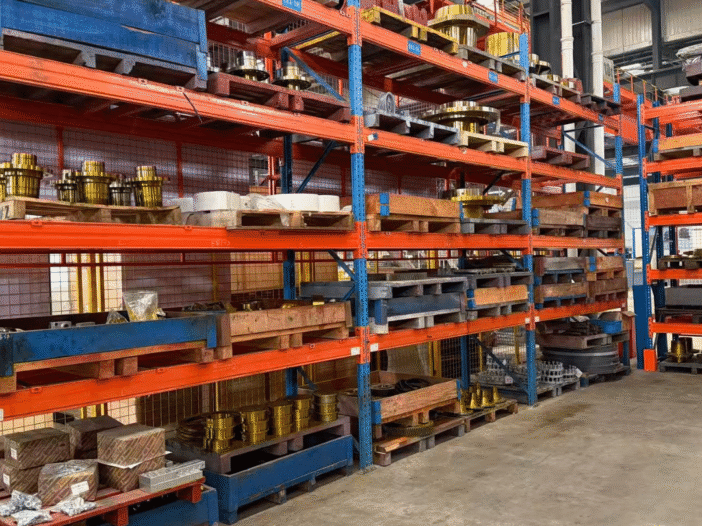
Every time a component wears out in a mineral processing plant, someone makes a decision: order the genuine part or find a cheaper alternative. It’s a decision made at the component level — often from a parts number and a price list — without much consideration for what that component is doing in the broader system.
Here’s what that system looks like. A mineral processing plant is built as a series of circuits — crushing, screening, washing — each engineered to take a raw feed and produce a specified output. Each circuit is assembled from individual pieces of equipment. Each piece of equipment is built from components — and those components are what keep the equipment performing the function the circuit was designed around.
The chain runs in both directions. The plant is designed to hit a production target. The circuits are engineered to support it. The equipment is specified to fit the circuit. And the components are manufactured to keep the equipment running to the original design standard. A part that doesn’t meet that standard doesn’t just fail at the component level. It introduces a gap in a chain that goes all the way back to your throughput target.
Two Categories, One Standard
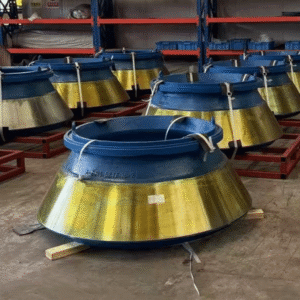
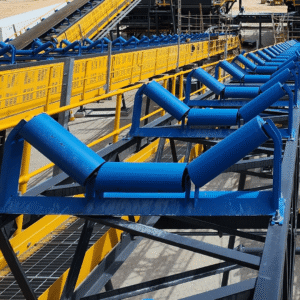
Wear Parts are the components designed to degrade predictably under abrasion and impact — crusher liners, feeder pans, and conveyor components. Because their degradation is measurable, maintenance can be planned around the wear curve.
Spare (Precision) Components are the mechanical pieces that rely on exact dimensional tolerances to transfer loads, transmit power, or maintain pressure — such as bushings, gears, and cylinders. Unlike wear parts, these do not typically degrade on a visible curve; they are designed to function correctly until they fail or require replacement during scheduled maintenance.
Regardless of the category, when a replacement part fails to meet the original design specification, the circuit pays the price.
What OEM Actually Means in This Context
A genuine OEM part is manufactured to the same specifications as the original component. When those specifications are met, parts fit correctly, performance is consistent, and the circuit behaves the way it was designed to behave. AMPCO Minerals is the original manufacturer. When you specify our parts, you are specifying the OEM standard — the same material grades, dimensional tolerances, and performance characteristics the circuit was designed around.
When alternative parts do not meet the original specification, the consequences are rarely immediate or obvious — but they are inevitable.
The differences may not be visible on inspection. They show up in fit issues that slow down changeouts, in performance that gradually diverges from design, and in failures that arrive without a clear cause.
A lower-cost alternative might seem economical, but if it wears out faster, fits poorly, or fails prematurely, it can damage adjacent, more expensive components. The true metric is cost per ton of production, not the unit price of the part.
The Impact of Precision-Fit Components
When precision-fit components (gears, bushings, cylinders) do not meet OEM specifications, the failure is rarely the part itself — it is the equipment surrounding it.
Bushings
Bushing dimensional tolerances determine how load is transferred between moving components. An out-of-spec bushing introduces misalignment at the contact point, which can lead to a loss of the lubricant’s cooling ability and significant damage to the surrounding critical internal components. These failures are rarely attributed to the bushing — because by the time the cause is identified, the damage has already been done to the equipment around it.
Gears
Gear geometry — tooth profile, pitch, and backlash — is engineered for a specific load and speed condition. Non-OEM gears that don’t match these parameters introduce vibration, uneven load distribution, and heat generation under operating conditions. The consequence is premature failure of the gear set and potential damage to connected drive components — a repair event significantly more costly than the gear itself.
Cylinders
Hydraulic cylinders rely on precise bore dimensions and seal compatibility to maintain operating pressure. An out-of-spec cylinder introduces leakage, pressure loss, and inconsistent actuation — and tends to fail at the point of highest operational demand, when the cost of downtime is greatest.
The Total Cost Question
The right question when specifying a replacement part isn’t “what does it cost?” It’s “what does it cost per ton of production?” A lower-cost alternative that wasn’t manufactured to AMPCO Minerals’ specifications — whether it wears faster, fits poorly, or fails early and damages adjacent parts — will cost more per ton than a genuine AMPCO Minerals part that performs to specification and keeps the circuit running as designed. That’s the calculation that matters — and one AMPCO Minerals’ aftermarket team is equipped to help you work through.
Need to review your parts inventory or discuss OEM specifications for your specific circuit? Visit our After-Sales Services page or contact our aftermarket team directly.