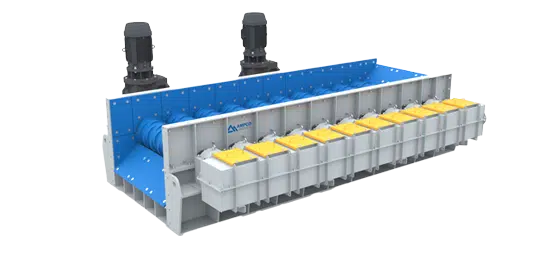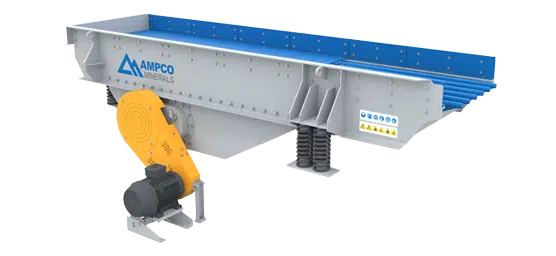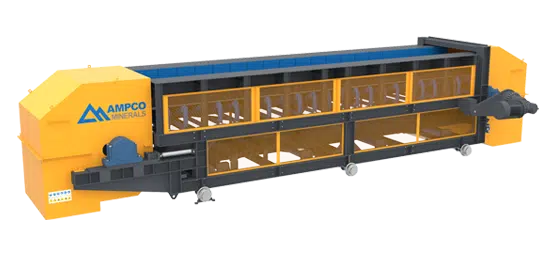
Apron Feeders
Learn More

AMPCO Minerals
Precision Volumetric Feed,
Engineered for Your Circuit
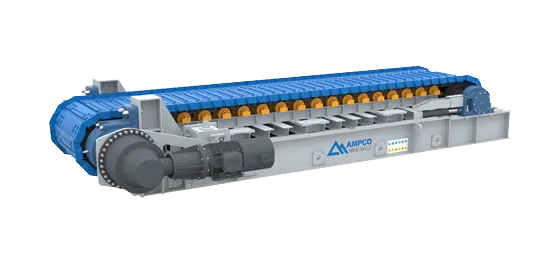
Where consistent volumetric feed rate and precise material control are the priority, the Belt Feeder is the right tool. Unlike vibrating feeders that rely on throw and frequency to move material, the Belt Feeder delivers a continuous, steady stream — making it particularly well suited for applications where feed consistency directly affects downstream process quality or equipment protection.
Belt Feeders are custom-engineered to the application. Hopper design, belt width and length, idler arrangement, and drive specification are all defined by your material, feed size, throughput target, and installation geometry — flat or inclined. There is no standard-off-the-shelf configuration because the variables that define the right Belt Feeder are specific to each circuit.
Contact us with your material specification, required feed rate, and installation constraints. We will engineer a configuration to match.
What applications is the Belt Feeder best suited for?
Belt Feeders are well suited for applications where consistent, controlled volumetric flow is the primary requirement — feeding crushers, screens, or other equipment that performs best with a steady, predictable input rate. They work across a wide range of material types, from dry aggregates to moderately wet feeds.
Is the Belt Feeder available in inclined configurations?
Yes. Both flat and inclined configurations are available. The inclination angle and belt specification are determined by your material characteristics, required capacity, and installation geometry. We review these parameters during the engineering phase to confirm the appropriate configuration.
How is the Belt Feeder specified — what information do you need from us?
To engineer the right Belt Feeder for your application, we need your material characteristics (type, maximum feed size, bulk density, moisture content), required feed rate (mtph or stph), installation geometry (flat or inclined, available space, discharge point), and any site-specific constraints. Contact us with these details and we will prepare a configuration recommendation.
Who do I contact to discuss whether the Belt Feeder is right for my application?
Contact your regional AMPCO Minerals sales representative or reach out through our website. We will ask about your material, feed size, throughput requirements, and site conditions — and give you a direct assessment of whether this feeder fits your circuit.
Let’s work together on your next project.
Contact Us